For years, the global autonomous vehicle race has been divided by a massive philosophical chasm. On one side stood Tesla, championing a “pure vision” approach that relies strictly on cameras and artificial intelligence. On the other side stood virtually the entire autonomous driving industry—especially in China—insisting that safe Level 4 autonomy is impossible without high-definition maps and expensive, roof-mounted LiDAR (Light Detection and Ranging) lasers.
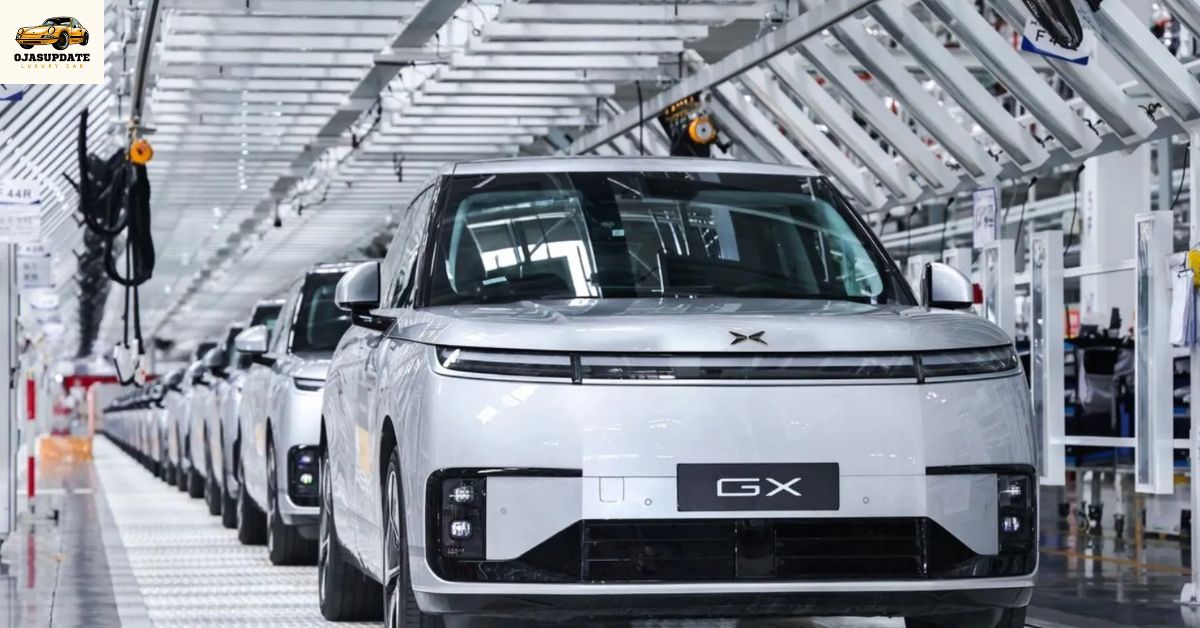
Chinese electric vehicle pioneer XPENG has officially rolled its first mass-produced robotaxi off the production line in Guangzhou. This milestone marks the first time a Chinese automaker has achieved mass production of a self-driving taxi built entirely via full-stack, in-house development. The headline feature sending shockwaves through the industry? It skips LiDAR completely.
The AI Powerhouse: What’s Under the Hood
Historically, Chinese autonomous fleets like Baidu’s Apollo Go or Geely’s newly unveiled EVA Cab have stacked their vehicles with up to 40+ sensors, including heavy arrays of LiDAR to map surroundings in 3D. XPENG is taking the opposite path, betting heavily on raw computing power and advanced neural networks over complex laser hardware.
To pull this off, the robotaxi is equipped with four proprietary, self-developed Turing AI chips. Together, they pump out a staggering 3,000 TOPS (trillions of operations per second) of on-board computing power. For context, that is roughly double the computing headroom of its closest domestic rivals, giving the vehicle the digital brainpower required to perceive, interpret, and react to chaotic urban traffic using camera footage alone.
Ditching the Laser: The Magic of VLA 2.0
Instead of feeding data through traditional, segmented coding pipelines that dictate “if-this-then-that” rules, XPENG’s robotaxi utilizes its breakthrough VLA 2.0 (Vision-Language-Action) end-to-end large model.
Traditional Autonomous vs. XPENG Pure Vision
| Feature | Traditional Robotaxi (e.g., Geely EVA) | XPENG Pure Vision Robotaxi |
| Primary Sensors | Cameras, Radar, Multiple LiDARs | Cameras Only |
| Mapping Reliance | High-Definition (HD) Pre-Mapping | Real-time AI Perception |
| System Latency | Higher (due to multi-sensor fusion) | Sub-80 Milliseconds |
| Scalability | Slow (restricted to pre-mapped cities) | Fast (can deploy anywhere globally) |
By eliminating the slow “language-translation” step found in older AV architectures, VLA 2.0 compresses the vehicle’s system response latency to under 80 milliseconds. This means the car is thinking, deciding, and acting faster than a human brain can register a brake light.
Furthermore, skipping high-definition maps means the robotaxi isn’t geofenced to a tiny, perfectly cataloged neighborhood. It perceives the world exactly like a human driver does, allowing it to seamlessly adapt to new cities, unexpected road construction, and complex detours on the fly.
The Business Logic: Why Scale Matters
XPENG’s decision to skip LiDAR isn’t just a technical flex; it is a cutthroat business strategy. LiDAR sensors are notoriously expensive, fragile, and difficult to calibrate at scale.
Instead of building a bespoke, steering-wheel-free pod from scratch, XPENG built its robotaxi on its existing GX platform—the same architecture underpinning its premium $58,000 consumer SUV.
“By utilizing a shared platform, XPENG can validate its hardware across millions of consumer cars on public roads, drastically cutting production costs and speeding up deployment.”
First-Class Passenger Experience
While the front seat handles the driving tech, the rear cabin has been optimized entirely for the ride-hailing public. The robotaxi will roll out in highly flexible five-, six-, and seven-seat configurations. Passengers are treated to a genuinely premium sanctuary featuring thick privacy glass, zero-gravity reclining comfort seats, and individual rear entertainment displays. A highly responsive built-in AI voice assistant allows riders to effortlessly adjust climate controls, interior lighting, and multimedia options.
The Road Ahead
The real-world test begins very soon. XPENG is launching official pilot operations for the robotaxi fleet in the second half of 2026 to iron out real-world edge cases.
While the vehicles will initially carry a human safety officer behind the wheel to satisfy regulatory protocols, the company’s roadmap is fiercely ambitious: they intend to remove safety personnel entirely and transition to 100% fully driverless commercial operation by early 2027.
About the Author