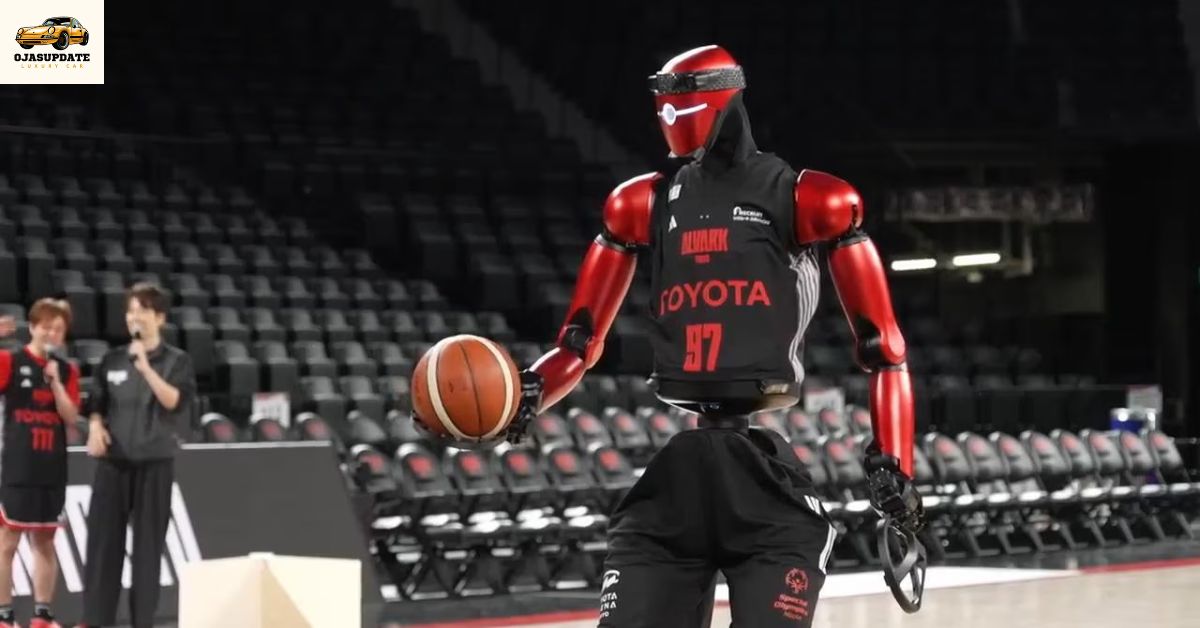
Toyota has unveiled its latest marvel, the CUE7 basketball robot, which debuted in April 2026 at Toyota Arena Tokyo. Unlike its predecessors, CUE7 can dribble, move fluidly across the court, and shoot with hybrid AI precision, marking a major leap in embodied robotics.
Origins of the CUE Project
- CUE series began in 2017 as a volunteer project by Toyota engineers.
- CUE3 (2019) set a Guinness World Record with 2,020 consecutive free throws.
- CUE6 (2024) achieved a record-breaking 24.55-meter shot.
- Each generation expanded capabilities: from stationary shooting to mobility, ball retrieval, and dribbling.
What Makes CUE7 Different
- Hybrid AI Control: Combines reinforcement learning (trial-and-error improvement) with model predictive control (real-time simulation for precise movements).
- Mobility Upgrade: Uses an inverted two-wheel base for dynamic stability, allowing smooth dribbling and movement across the court.
- Weight Reduction: At 74 kg, it’s nearly 40% lighter than CUE6, enabling faster, more agile performance.
- Human-like Movements: CUE7 can dribble, reposition, and shoot with fluidity that mimics professional athletes.
Debut and Public Reception
- Debut Date: April 12, 2026, during halftime at an Alvark Tokyo home game.
- Venue: Toyota Arena Tokyo.
- Reception: Met with thunderous applause, symbolizing pride in Japanese innovation and Toyota’s engineering prowess.
Technical and Cultural Impact
- Embodied AI Research: CUE7 is more than a sports novelty; it’s a testbed for robotics in vision-based target acquisition, trajectory planning, and force control.
- Symbol of Innovation: The development team emphasized that CUE7 represents Toyota’s determination to remain a global leader in technology.
- Cultural Resonance: Basketball provides a relatable, structured environment to showcase robotics, bridging entertainment and research.
Comparison of CUE Generations
| CUE3 | CUE6 | CUE7 |
|---|---|---|
| 2019 debut | 2022 debut | 2026 debut |
| 2,020 consecutive free throws | 24.55m long-distance shot | Dribbling, mobility, hybrid AI |
| Stationary shooter | Limited mobility | Full dynamic movement |
| Guinness World Record | Guinness World Record | First “full model change” |
Risks and Challenges
- Technical Complexity: Hybrid AI systems require extensive training and calibration, which may limit scalability.
- Public Perception: While celebrated, some critics argue robots in sports could overshadow human athletes.
- Future Applications: The challenge lies in translating basketball-specific skills into broader robotics use cases.
Conclusion
Toyota’s CUE7 robot is not just a basketball-playing machine—it’s a symbol of how robotics can merge entertainment, research, and cultural pride. By combining lightweight design, hybrid AI, and fluid human-like motion, CUE7 sets a new benchmark in embodied AI. Its debut signals Toyota’s ambition to lead beyond automobiles, shaping the future of robotics in everyday life.
About the Author