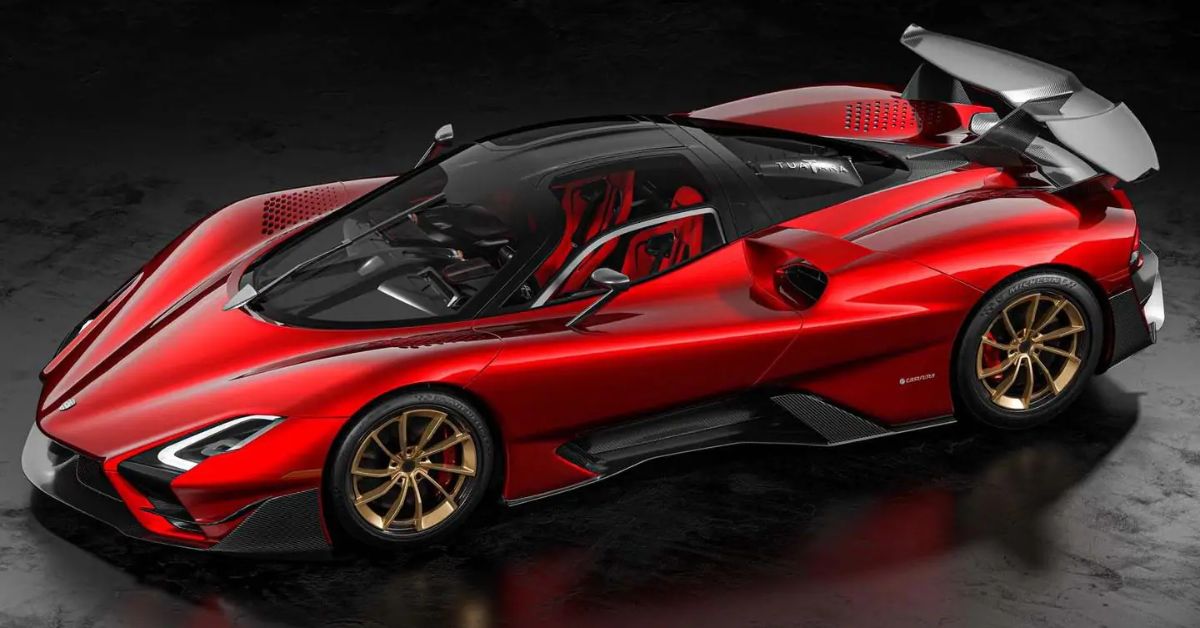
The world of hypercars is a constant arms race, with manufacturers pushing the boundaries of speed, technology, and design. Among them, the SSC Tuatara stands out as one of the most ambitious projects ever undertaken. Built by SSC North America, the Tuatara has long been associated with extreme velocity, and the 2026 update cements its reputation as a car designed not just to break records, but to challenge the very limits of physics.
🚗 Engineering the Beast
At the heart of the Tuatara lies a 5.9-liter twin-turbocharged V8, producing up to 1,850 horsepower when running on E85 fuel. This immense power is paired with a lightweight carbon-fiber monocoque chassis, ensuring both strength and agility.
- Transmission: A 7-speed automated manual gearbox delivers lightning-fast shifts.
- Aerodynamics: Sculpted in wind tunnels, the Tuatara boasts a drag coefficient of just 0.279 Cd, one of the lowest in its class.
- Suspension: The 2026 model introduces an AI-powered active suspension system, capable of making 300 real-time adjustments per second.
Together, these innovations create a machine that is as stable at 300 mph as most cars are at highway speeds.
⚡ Record-Breaking Ambitions
The Tuatara has already proven its mettle with verified runs exceeding 282 mph (455 km/h). But SSC’s ambitions go further: the 2026 Tuatara is engineered to surpass 500 km/h (310 mph), potentially making it the fastest production car in history.
- Simulated top speed: 330 mph (531 km/h).
- Acceleration: 0–60 mph in under 2.5 seconds.
- Braking: Carbon-ceramic brakes ensure rapid deceleration from extreme speeds.
These figures place the Tuatara in direct competition with hypercar legends like the Bugatti Chiron Super Sport, Koenigsegg Jesko Absolut, and Rimac Nevera.
🎨 Design Philosophy
The Tuatara’s design is inspired by aerospace engineering, blending futuristic aesthetics with functional aerodynamics.
- Exterior: Sleek, low-slung body with butterfly doors.
- Interior: Minimalist cockpit featuring digital displays and driver-focused ergonomics.
- Weight: Extensive use of carbon fiber keeps curb weight around 1,247 kg, enhancing agility.
Every curve and surface is optimized for airflow, ensuring stability at supersonic speeds.
⚖️ SSC Tuatara vs. Rivals
| Hypercar | Power Output | Top Speed (claimed/simulated) | Key Highlight |
|---|---|---|---|
| SSC Tuatara (2026) | 1,850 hp | 330 mph (simulated) | AI suspension, lowest drag |
| Bugatti Chiron Super Sport | 1,578 hp | 304 mph (tested) | Proven high-speed run |
| Koenigsegg Jesko Absolut | 1,600 hp | 330+ mph (simulated) | Drag-reducing design |
| Rimac Nevera R | 1,914 hp | 258 mph (tested) | Electric acceleration dominance |
🌍 Market Impact
The Tuatara represents more than just speed—it’s a symbol of American engineering ambition.
- Exclusivity: Production is limited, with each car priced at over $2 million.
- Prestige: Owning a Tuatara is not just about performance, but about joining a select group of enthusiasts chasing the ultimate thrill.
- Innovation: SSC’s focus on aerodynamics and AI suspension could influence future performance cars.
✨ Final Thoughts
The SSC Tuatara 2026 is not just a hypercar—it’s a land missile designed to challenge the boundaries of what’s possible on four wheels. With its 1,850 hp V8, AI-driven suspension, and simulated speeds beyond 330 mph, it embodies the relentless pursuit of speed and innovation.
For SSC North America, the Tuatara is more than a car—it’s a statement: that the quest for ultimate velocity is alive and well, and that the future of hypercars will continue to be defined by those daring enough to chase physics itself.
About the Author