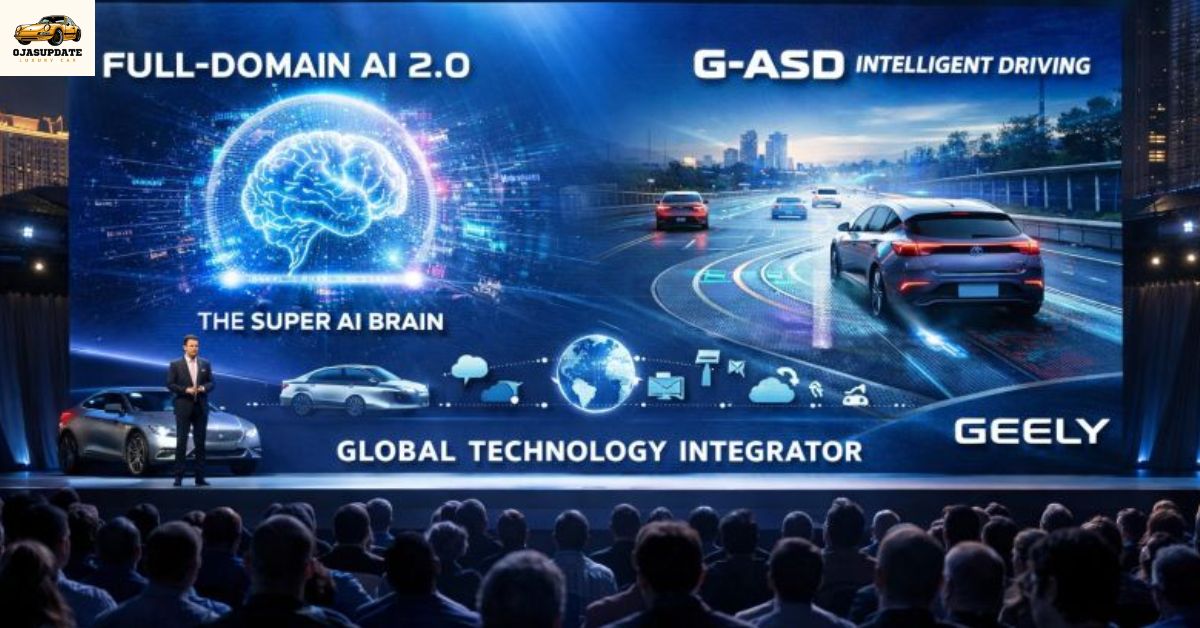
At CES 2026, Geely Auto Group showcased its vision for the next era of intelligent mobility by unveiling Full-Domain AI 2.0 and the G-ASD (Geely Afari Smart Driving) system. This announcement marks Geely’s third consecutive appearance at CES and underscores its ambition to lead the global transition toward software-defined, AI-powered vehicles.
What Is Full-Domain AI 2.0?
Geely’s Full-Domain AI 2.0 represents a significant evolution from its earlier 1.0 framework. Instead of fragmented, module-based intelligence, the new system introduces a unified, vehicle-wide AI architecture.
- Integration Across Domains: AI now coordinates cockpit, chassis, safety, and driving functions in real time.
- Centralized Scheduling: Computing power and data streams are managed holistically, ensuring seamless communication between systems.
- Adaptive Intelligence: Vehicles gain an evolving “worldview,” enabling judgment and reasoning beyond simple automation.
This shift transforms cars from feature-driven machines into adaptive, learning platforms capable of handling complex real-world scenarios.
Key Features and Innovations
1. Unified AI Architecture
- Moves away from siloed modules to a full-domain approach.
- Enhances responsiveness and coordination across critical systems.
2. G-ASD Intelligent Driving System
- Designed to accelerate the transition to Level 3 and Level 4 autonomy.
- Uses AI-driven perception and decision-making to handle rare and complex driving scenarios.
3. World Action Model (WAM)
- Introduced alongside AI 2.0, WAM gives vehicles a dynamic worldview, allowing them to interpret and act in unpredictable environments.
4. Cloud-Native Development
- Supports OTA (over-the-air) updates, ensuring vehicles remain future-proof.
- Enables collaboration across Geely’s global R&D hubs.
Why It Matters
For Drivers
- Safer Journeys: AI-driven coordination reduces risks in complex traffic conditions.
- Personalized Experiences: Cockpit systems adapt to driver preferences in real time.
- Continuous Upgrades: OTA updates keep vehicles current without hardware changes.
For Automakers
- Reduced Complexity: Unified architecture simplifies design and integration.
- Scalability: Easier to deploy across multiple vehicle models.
- Competitive Edge: Positions Geely as a leader in AI-driven mobility.
Comparison: AI 1.0 vs AI 2.0
| Feature | Full-Domain AI 1.0 | Full-Domain AI 2.0 |
|---|---|---|
| Architecture | Module-based | Unified, vehicle-wide |
| System Coordination | Limited | Real-time, holistic |
| Autonomy Support | Basic L2/L3 | Advanced L3/L4 |
| Adaptability | Static features | Dynamic, evolving worldview |
| OTA Updates | Limited | Fully supported |
Challenges Ahead
While Full-Domain AI 2.0 is groundbreaking, several challenges remain:
- Computational Demands: High-performance AI requires significant processing power.
- Cybersecurity Risks: Unified systems increase exposure to hacking, demanding robust safeguards.
- Regulatory Standards: Global adoption depends on harmonized safety and AI regulations.
The Road Ahead
Geely’s Full-Domain AI 2.0 is more than a technical upgrade—it’s a strategic blueprint for the future of mobility. By integrating AI across every vehicle domain and launching G-ASD, Geely is preparing cars to handle the unpredictability of real-world driving while offering consumers safer, smarter, and continuously evolving experiences.
As the automotive industry races toward electrification, autonomy, and connectivity, Geely’s innovations could set the benchmark for software-defined vehicles worldwide.
Conclusion
The unveiling of Full-Domain AI 2.0 at CES 2026 marks a turning point in automotive intelligence. By moving from fragmented modules to a unified AI ecosystem, Geely is redefining what it means to build a smart vehicle. Coupled with the G-ASD system, this innovation accelerates the path to high-level autonomy and positions Geely as a trailblazer in intelligent mobility.
For consumers, it promises cars that are safer, smarter, and endlessly adaptable. For the industry, it signals the dawn of a new era where vehicles are not just driven—they are thinking companions on the road.
About the Author