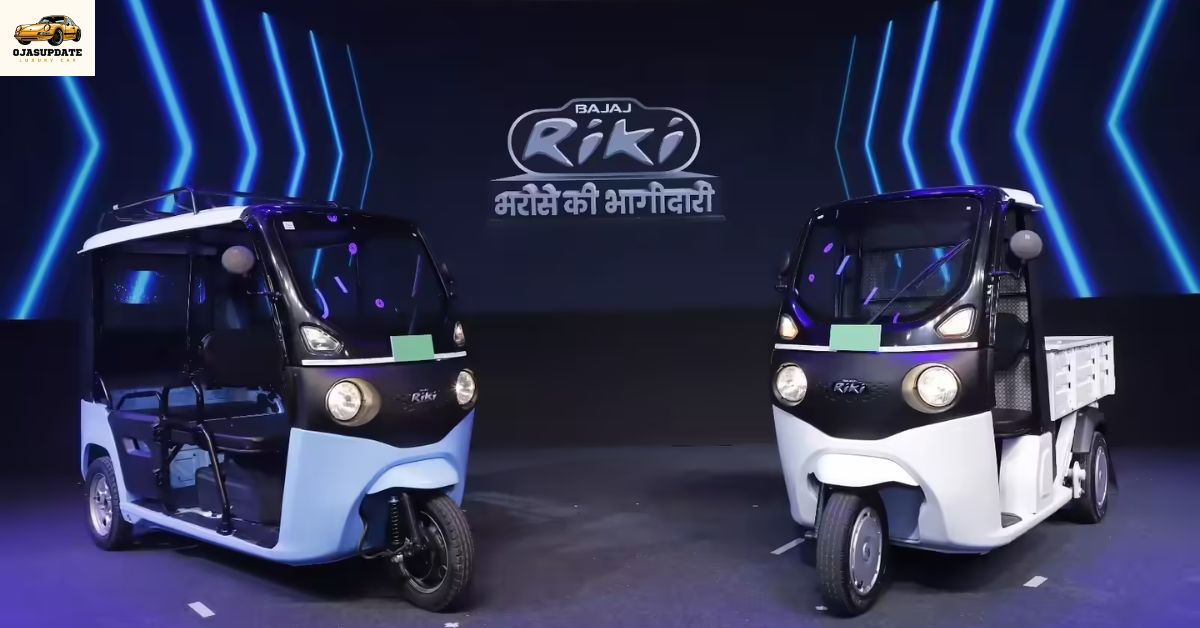
India’s e-rickshaw market has exploded in recent years, with monthly sales surging past 45,000 units. Despite this growth, the segment has long struggled with issues like poor range, unreliable braking, fragile chassis, and limited service support. Bajaj Auto, the country’s largest three-wheeler manufacturer, has now stepped in with a solution: the Bajaj Riki series, its first-ever electric rickshaw lineup.
The Launch and Market Context
Bajaj unveiled the Riki series after successful pilot trials across four cities. With the official rollout, the company plans to expand availability to 25 cities initially, and eventually to 100+ towns nationwide. This move is strategic—while over 500 brands currently compete in the e-rickshaw space, most are small-scale players. Bajaj’s entry brings trust, reliability, and nationwide service support to a fragmented market.
Samardeep Subandh, President of Bajaj Auto’s Intracity Business Unit, highlighted that e-rickshaws now account for 38% of India’s three-wheeler market, making them a critical part of urban mobility.
Models and Pricing
Bajaj has introduced two variants under the new P40 series:
| Model | Type | Price (Ex-Showroom) | Certified Range | Key Features |
|---|---|---|---|---|
| Riki P4005 | Passenger | ₹1,90,890 | 149 km | 5.4 kWh battery, monocoque chassis, hydraulic brakes |
| Riki C4005 | Cargo | ₹2,00,876 | 164 km | Larger cargo space, reinforced chassis, fast charging |
These prices position Riki competitively against rivals, while offering longer range and better durability.
Key Features That Set Riki Apart
- Longest Range in Segment: Up to 164 km per charge, reducing downtime and boosting driver earnings.
- Fast Charging: Full charge in just 4 hours, compared to 6–8 hours for many competitors.
- Safer Design: A monocoque chassis engineered for stability and durability.
- Hydraulic Brakes: Improved braking performance for safer rides.
- Cargo Flexibility: The C4005 variant offers expanded cargo space, ideal for delivery businesses.
- Nationwide Service Network: Bajaj’s established dealer and service ecosystem ensures reliability.
Why Riki Matters for Drivers and Businesses
For drivers, the Riki promises higher daily income thanks to longer range and reduced charging downtime. For businesses, especially logistics and delivery operators, the cargo variant offers a cost-effective, eco-friendly alternative to traditional three-wheelers.
Moreover, Bajaj’s entry addresses long-standing pain points in the sector:
- Durability: Stronger chassis reduces breakdowns.
- Safety: Better braking and stability minimize accidents.
- Support: Nationwide service ensures consistent uptime.
Challenges and Opportunities
While Bajaj’s Riki is a strong product, challenges remain:
- Competition: With 500+ brands already in the market, differentiation is key.
- Cost Sensitivity: Even at ₹1.9 lakh, affordability for small operators may be a hurdle.
- Infrastructure: Charging facilities must expand to support widespread adoption.
However, opportunities are immense:
- Urban Mobility: Riki can dominate last-mile connectivity to metro stations, bus stops, and railway hubs.
- Green Transition: As cities push for cleaner transport, Riki aligns perfectly with sustainability goals.
- Brand Trust: Bajaj’s reputation in the three-wheeler space gives it a competitive edge.
Final Thoughts
The Bajaj Riki series marks a turning point in India’s e-rickshaw industry. By combining long range, fast charging, safer design, and nationwide support, Bajaj has set new benchmarks for the segment.
For drivers, Riki means better earnings and reliability. For businesses, it’s a sustainable logistics solution. And for India, it represents another step toward cleaner, smarter urban mobility.
With its competitive pricing and strong brand backing, the Bajaj Riki is poised to become a game-changer in last-mile transport, redefining how millions of Indians commute and how businesses deliver goods.
About the Author